
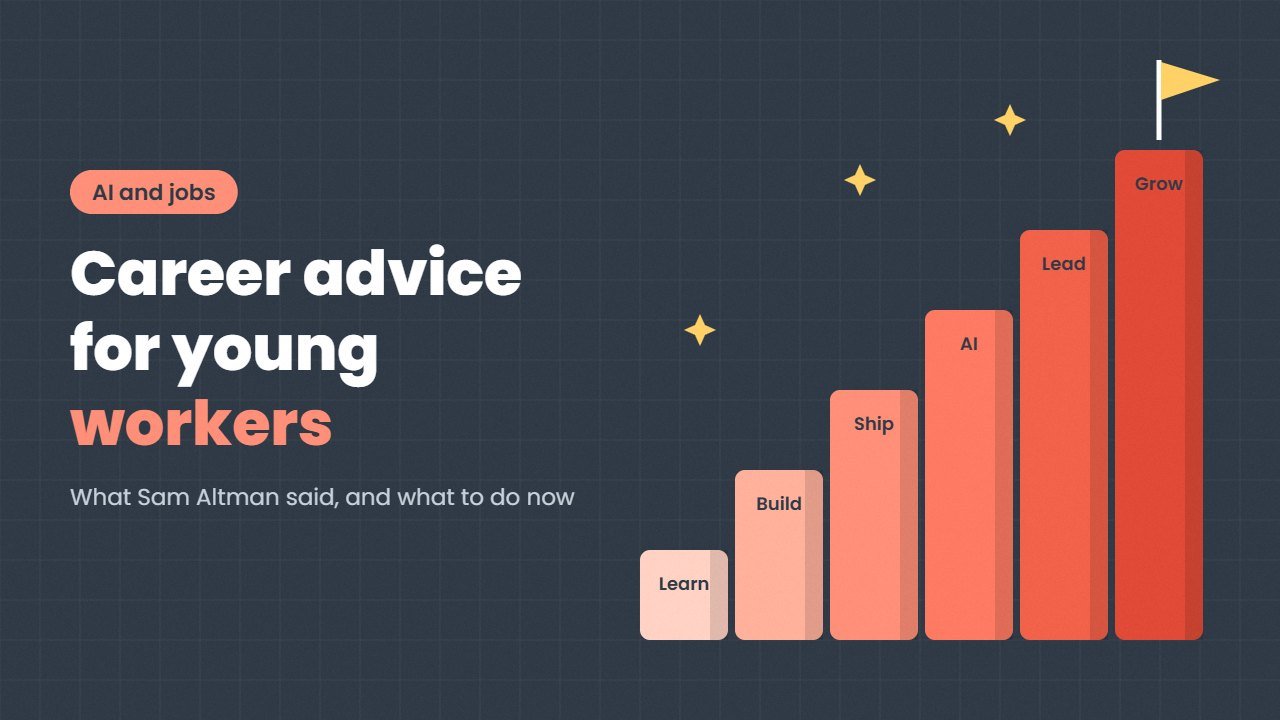
Sam Altman career advice is trending after the OpenAI CEO told young people to stop chasing old dream jobs. He said this in a Stanford Graduate School of Business interview released on October 21, 2026, according to TheStreet. His message was simple: big change is the best time to start. Below, we explain what he said, what the job data shows, and what you can do this month.
What Sam Altman said at Stanford
Altman spoke on Stanford GSB’s “View From The Top” series. MBA student Claudia Chen asked him about AI and the future of work. Fortune, TheStreet and TechRadar reported his answers between October 28 and 29.
His main point was that MBA students often want the job that was cool five years ago. He called this his “chronic disappointment”, according to TechRadar. Instead, he urged them to pick the new path. In his words, reported by TheStreet: “I think this is a great time to go do the new thing.”
He also gave a reason. He said you want to start a career during the greatest change, because the field is most open. People with drive and fresh ideas, he added, “tend to do relatively well when the ground is shaking the most,” as Fortune reported.
He said huge numbers of tasks will be done better, cheaper and faster by AI. However, he also said the shift will take longer than many people expect. TheStreet adds that he does not see a job apocalypse. Finally, he said companies built on OpenAI’s technology could one day be bigger than OpenAI.
What the job data says about AI and entry level work
Altman’s view matters because young workers are already feeling pressure. Here are three data points from credible sources.
First, the New York Fed says the unemployment rate for recent college graduates was about 5.6% in the second quarter of 2026. Their underemployment rate was 42%. That means many graduates work in jobs that do not need a degree.
Second, a Stanford Digital Economy Lab study looked at ADP payroll data through June 2026. It found that workers aged 22 to 25 in AI exposed jobs had employment 19% below where it would be if they had kept pace with less exposed peers. Experienced workers showed no similar gap.
The same study has a useful detail. Declines cluster where AI replaces tasks, mostly through less hiring. Where AI helps workers do more, employment stayed flat or rose. The authors call these early signs, not proof of cause.
Third, there is a bright side. Fortune reported that Americans filed 5.7 million applications to start businesses in 2025. Fortune says that is the highest yearly total in two decades of Census Bureau tracking. So more people are testing the “new thing” Altman described.
Turning Sam Altman career advice into action
“Do the new thing” is easy to say and hard to use. So here are seven concrete steps based on the data above.
- Audit a real job post. First, pick one entry level listing you want. Split its tasks into three groups: AI does it, you do it with AI, or it needs people. Aim for roles where most tasks land in the last two groups, because the Stanford data shows those jobs are holding up.
- Ship three small projects. Next, build proof instead of only collecting certificates. For example, a marketing student could run a small campaign for a local shop with AI drafts. Then write one page on what worked, what failed and what you fixed.
- Show your checking skills. AI makes mistakes, and employers need people who catch them. So keep a log of errors you found in AI output and how you corrected them. This becomes a strong interview story.
- Learn the tools in your own field. Also, skip generic hype. Ask two people in your target job which AI tools they use every week. Then practise those, starting with our list of free AI tools for students.
- Run a weekend business test. Altman pointed to new companies built on AI. In addition, you can test one small service, such as AI assisted resume editing or product photos. Try to land five paying customers before you spend money.
- Build people skills on purpose. Meanwhile, sales, client calls and teamwork are harder to hand to software. Volunteer for tasks that put you in front of real customers.
- Protect your data. Finally, never paste client files, passwords or private records into a chatbot. Our Sam Altman AI cybersecurity article covers the safety side in more detail.
Free: AI Tools Cheat Sheet 2026
24 free tools sorted by task, a simple prompt formula and 10 prompts you can copy. We send the PDF straight to your inbox.
Sent! Check your inbox
We emailed the AI Tools Cheat Sheet to you. Not there in 2 minutes? Look in Spam or Promotions.
A 30 day plan built on Sam Altman career advice
If you want structure, use this plan. It fits around classes or a full time job.
| Week | Goal | Output |
|---|---|---|
| Week 1 | Audit two job posts | A task list marked by AI risk |
| Week 2 | Learn one tool your field uses | Notes on three real uses |
| Week 3 | Finish one small project | A one page case study |
| Week 4 | Share it and talk to people | Five messages to people in your target field |
After 30 days, you will have proof of work, a clearer target and new contacts. As a result, your next application will show skills, not just claims.
Where the advice has limits
This Sam Altman career advice comes from someone who runs one of the biggest AI companies. Of course, he has a reason to be upbeat about AI. So read his view next to the data, not instead of it.
Also, “do the new thing” carries more risk for people without savings or family support. A safer middle path is to keep a stable job or course, and test new ideas on the side. In short, take bold steps, but size them to what you can afford to lose.
Bottom line
Sam Altman career advice comes down to this: do not train for the job market of five years ago. The data backs part of his view, since AI is hitting tasks it can replace while roles it supports hold up. So pick work where AI makes you better, build visible proof and test small ideas early.
Frequently asked questions
Where did Sam Altman give this career advice?
He spoke in Stanford Graduate School of Business’s “View From The Top” interview series. TheStreet says it was released on October 21, 2026. Fortune, TheStreet and TechRadar covered it later that month.
Does Sam Altman think AI will cause mass job losses?
He said AI will do huge numbers of tasks better and cheaper. However, he also said the change will be slower than many expect. TheStreet reports that he does not see a job apocalypse.
Is Sam Altman career advice useful outside the US?
Yes, mostly. His core idea is to build skills where AI helps you, not where it replaces you. That applies in any country, although the job data in this article is from the US.
Which jobs are safest for young workers right now?
No job is fully safe. Still, the Stanford study found that roles where AI supports workers held steady or grew. Roles where AI replaces tasks saw the biggest drops for workers aged 22 to 25.