
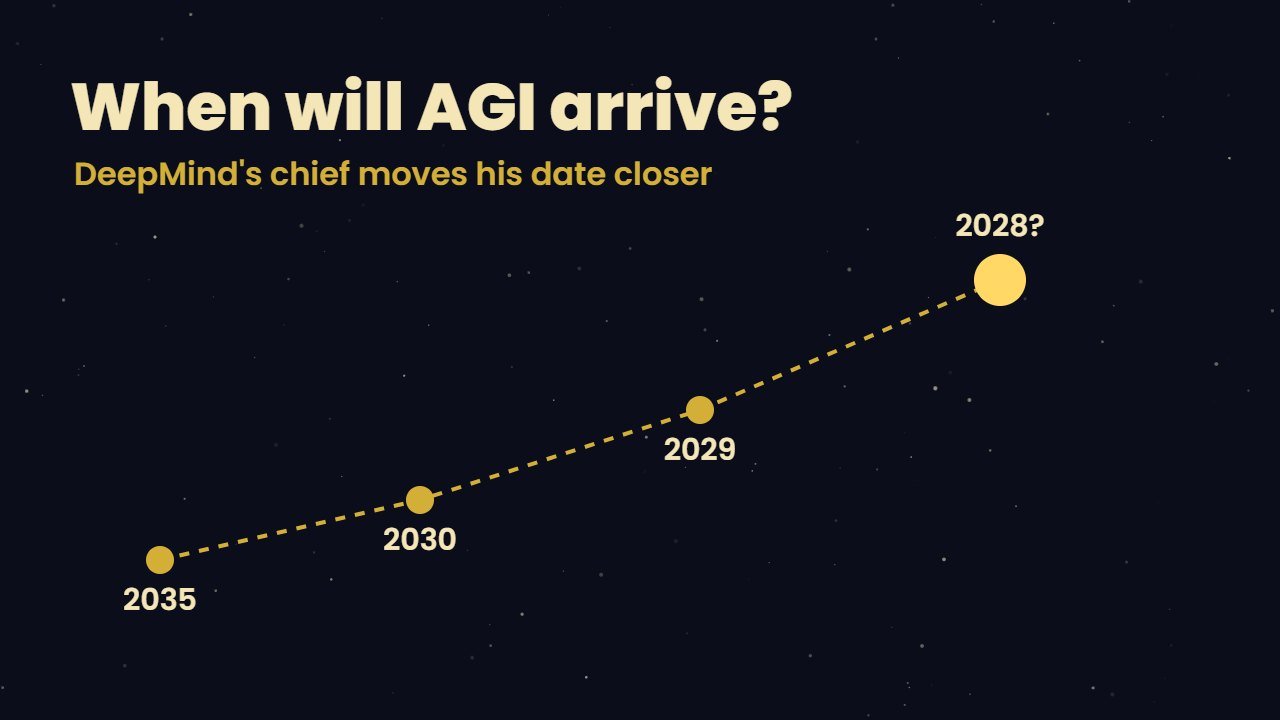
Demis Hassabis, the chairman of Google DeepMind and Alphabet’s chief scientist, now says artificial general intelligence could arrive in just two to three years. In an interview with The Wall Street Journal Magazine published on 21 October 2026, he moved his timeline closer once again, pointing to roughly 2028. This Demis Hassabis AGI prediction matters because he chairs the lab behind Gemini and won a Nobel Prize for AlphaFold. In this article, we explain what he said, how his view has changed through 2026, what AGI actually means, and what it could mean for you.
What Demis Hassabis Said About AGI
In the WSJ Magazine interview, Hassabis said AGI is coming soon and that he keeps moving his own estimate nearer. Earlier in 2026, he had talked about three to five years. Now, reports of the interview place his estimate at two to three years, which points to 2028 or 2029.
He has also admitted something important. In a May 2026 Axios interview, he said part of his urgent tone aims to push governments, economists and the public to prepare for the technology now, rather than after it arrives.
How the Demis Hassabis AGI Timeline Changed
The Demis Hassabis AGI timeline has shortened step by step. Here is how it moved, based on his public interviews and talks:
| When | Where | What he said |
|---|---|---|
| January 2026 | World Economic Forum, Davos | AGI could still be five to ten years away |
| February 2026 | India AI Impact Summit | AGI is on the horizon, maybe within five years |
| May 2026 | Axios interview after Google I/O | Around 2030, possibly 2029; today’s AI agents are a practice run |
| October 2026 | WSJ Magazine | Two to three years, roughly 2028 |
In other words, his estimate has moved forward by several years in less than a year. As a result, the gap between his view and the more hopeful forecasts from other AI leaders is now much smaller.
What Is AGI, in Simple Words?
AGI means an AI system that can learn and do almost any thinking task a skilled human can do. Today’s chatbots are very good at many tasks, but they still make basic mistakes and need close supervision.
Google DeepMind has published a framework for measuring progress toward AGI. It treats AGI as levels rather than a single finish line. Systems move from emerging to competent, then expert, then exceptional, and finally superhuman. The framework also looks at how broad a system’s skills are and how much it can act on its own. Still, there is no single test that everyone agrees on to declare that AGI has arrived.
What Is Still Missing Before AGI
Even Hassabis says today’s AI is not there yet. In a 2026 interview with Y Combinator, he named several gaps that researchers still need to close.
- Continuous learning. Humans learn from new experiences and keep that knowledge. In contrast, AI models do not update their core knowledge every time they meet something new.
- Memory. Even with long context windows, AI assistants can lose track of details across long tasks and conversations.
- Consistent reasoning. AI can solve hard maths problems, yet it can still fail at simple logic. Hassabis has said a true AGI should perform reliably across all kinds of thinking tasks.
- New ideas. He has long used one benchmark for AGI: a system that can invent its own scientific ideas, not just solve problems people give it.
Why the Demis Hassabis AGI Prediction Matters
Hassabis is not a typical tech chief. He trained as a neuroscientist, co-founded DeepMind in 2010, and shared the 2024 Nobel Prize in Chemistry for AlphaFold, which predicts protein structures. Because of that background, many people see him as one of the more careful voices in AI.
Moreover, he chairs the lab that builds Gemini, so he sees the progress of frontier models from the inside. Much of his recent confidence comes from AI agents, which can plan and carry out multistep tasks with tools. If you are new to agents, our guide on what an AI agent is explains them with real examples.
What the Demis Hassabis AGI Forecast Means for You
For everyday users, the near term change is simple: AI tools will likely become more capable and more independent quickly. For example, today you might ask an assistant to summarise emails. In a few years, you may hand it a whole project, such as planning a trip or preparing a report, and check the result at the end.
At work, more capable AI could take on research, analysis and admin tasks. In science, it could speed up drug discovery, an area where DeepMind’s sister company Isomorphic Labs already works. On the other hand, there are real worries about jobs, privacy, security and mistakes made by systems that act on their own.
So what should you do now? First, learn to use today’s AI tools well, because the skills carry over. Next, check AI output before you rely on it, since accuracy is still the weak point. Finally, keep your data private where it matters; our guide to AI training opt out shows how.
Should You Believe the 2028 Timeline?
Treat it as an informed forecast, not a promise. AI leaders have missed timelines before, and nobody agrees on exactly what counts as AGI. Some researchers argue that current methods will hit limits without new breakthroughs, and Hassabis himself says some key problems remain unsolved.
Even so, the direction is clear. One of the most cautious leaders in the field now expects human level AI within this decade, and possibly within a few years. That alone makes it worth paying attention. For the latest updates, follow our AI News section.
FAQ
When does Demis Hassabis think AGI will arrive?
In October 2026, he said AGI could arrive within two to three years, which points to around 2028. Earlier in 2026, he had suggested around 2030.
What is the difference between AI and AGI?
Today’s AI is strong at specific tasks but makes mistakes and needs supervision. AGI would handle almost any thinking task a skilled person can, and adapt to new problems on its own.
Has any company reached AGI yet?
No. No lab has shown a system that experts broadly accept as AGI, and there is still no agreed test to prove it.