
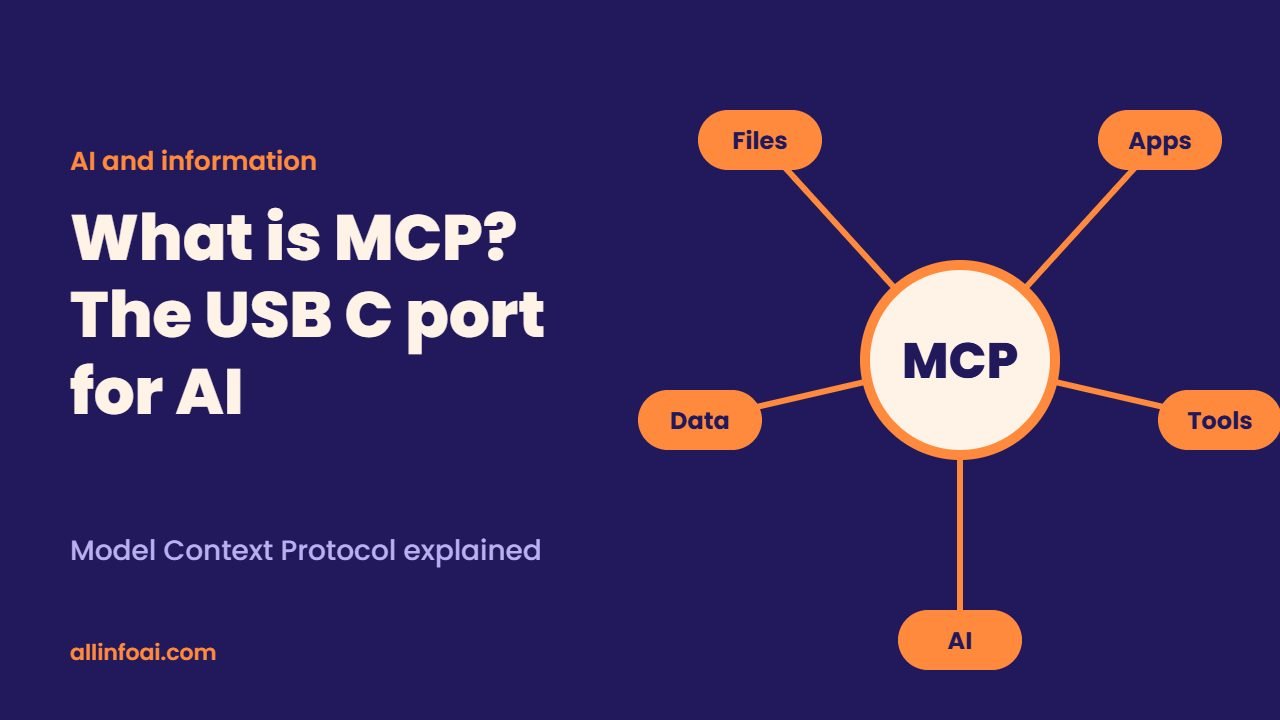
If you use AI tools, you have probably seen three letters everywhere lately: MCP. ChatGPT, Claude, Gemini, VS Code and Windows all talk about it. Yet most explanations jump straight into code.
This guide answers what is MCP in plain English. You will learn how it works, who supports it, where it can go wrong and how to try it in ten minutes.
Quick answer: MCP, the Model Context Protocol, is an open standard that lets AI apps connect to outside tools and data in one common way. Instead of building a custom link for every app, a developer builds one MCP server, and any MCP ready AI app can use it. Anthropic created it in November 2024, and it now sits under a Linux Foundation project.
What is MCP in simple terms?
Think about chargers. Years ago, every phone had its own plug. Then USB C arrived, and one cable fit almost everything. People often call MCP the USB C port for AI, and the comparison works well.
Before MCP, an AI assistant that needed your files, your calendar or your company database needed a custom integration for each one. Every AI app built its own version. As a result, the same work happened again and again.
The protocol fixes that with one shared language. A tool maker builds an MCP server once. Then Claude, ChatGPT, Cursor or any other app that speaks MCP can plug into it.
Who created it and who runs it now
Anthropic introduced MCP on 25 November 2024. It launched with the spec, developer kits, support in the Claude desktop app and ready made servers for Google Drive, Slack, GitHub, Git, Postgres and Puppeteer.
Then adoption spread fast:
- March 2025: OpenAI adopted MCP, starting with its Agents SDK.
- April 2025: Google DeepMind CEO Demis Hassabis said Gemini models and the Gemini SDK would support it.
- May 2025: Microsoft announced native MCP support coming to Windows 11, and Microsoft and GitHub joined the MCP steering committee.
- September 2025: the official MCP Registry launched in preview.
- December 2025: Anthropic donated MCP to the Agentic AI Foundation, a directed fund under the Linux Foundation co founded by Anthropic, Block and OpenAI.
So no single company owns it today. In addition, the official SDKs are huge: the MCP team said in July 2026 that its TypeScript and Python SDKs had each passed one billion total downloads.
How the protocol works
To begin with, MCP has three main parts. The official architecture guide uses these names:
- Host: the AI app you use, such as Claude Desktop, ChatGPT or VS Code.
- Client: a small connector inside the host. The host creates one client for each server it connects to.
- Server: a program that offers data or actions, such as a file server, a GitHub server or a database server.
A server can run on your own computer or on the internet. Local servers talk through standard input and output. Remote servers use a web connection called Streamable HTTP, usually with OAuth sign in.
The flow is simple. First, the app asks the server what it offers. Next, the AI model picks a tool. The app then sends the request, and the result goes back to the model, which uses it in its answer.
Tools, resources and prompts
In short, every MCP server can share three kinds of things:
| Part | What it is | Example |
|---|---|---|
| Tools | Actions the AI can take | Create a GitHub issue, run a database query |
| Resources | Read only information | A file’s contents, a database layout |
| Prompts | Ready made templates | A code review checklist, a report format |
There is also a client feature called elicitation, which lets a server ask you a question or request a confirmation. The latest spec, dated 28 July 2026, made the protocol stateless and retired some older features, but you do not need those details to use it.
Real examples in action
- Files: in Claude Desktop, a file server lets the AI read, create and sort files in folders you allow.
- Code: a GitHub server lets an assistant list open issues or open a pull request.
- Errors: a Sentry server pulls crash reports straight into your coding assistant.
- Databases: a Postgres server gives the AI a query tool, the schema as a resource and example queries as prompts.
- Work apps: Slack, Google Drive, Notion and Figma connectors appear as remote MCP servers in many AI apps.
It also pairs well with retrieval methods. If you want AI to answer from your own documents, read our guide to RAG, and see how both feed AI agents.
Free: AI Tools Cheat Sheet 2026
24 free tools sorted by task, a simple prompt formula and 10 prompts you can copy. We send the PDF straight to your inbox.
Sent! Check your inbox
We emailed the AI Tools Cheat Sheet to you. Not there in 2 minutes? Look in Spam or Promotions.
Is MCP safe?
The protocol is a pipe, and a pipe can carry bad things too. Here are the main risks:
- Prompt injection: text a server returns, like a web page or an email, can hide instructions that try to steer the AI.
- Tool poisoning: security firm Invariant Labs showed in April 2025 that a tool’s description can hide commands the user never sees, for example telling the model to read private SSH keys.
- Bad local servers: a local server runs with your user permissions, so a harmful package can run any code.
- Loose access tokens: a remote server with wide permissions can do more damage if it is misused.
The spec itself says a human should always be able to deny tool actions. So follow these habits:
- Install servers only from trusted publishers, such as the official registry or the vendor itself.
- Give file servers access to specific folders, never your whole drive.
- Read each action before you approve it.
- Prefer official remote servers with OAuth over random scripts.
- Pin versions so a server cannot quietly change after you approve it.
The MCP security best practices page covers more.
How to try MCP in ten minutes
For most beginners, the easiest path is a ready made connector inside an app like Claude or ChatGPT. If you want to see the real thing, the official quickstart works like this:
- Install Claude Desktop and Node.js.
- In Claude, open Settings, then Developer, then Edit Config.
- Add the filesystem server and point it at one folder, such as your Desktop.
- Quit and restart Claude, then check that the server appears under connectors.
- Ask Claude to write a short note and save it to that folder, then approve the action.
After that, developers can go further with the MCP Inspector and the Python or TypeScript SDK.
Also read: DeepSeek Super Agent: The Open Source Coding Agent That Stays On
FAQ
What is MCP in AI?
MCP, or Model Context Protocol, is an open standard that lets AI apps connect to tools and data through one shared method.
Who owns the Model Context Protocol?
Anthropic created it in November 2024. In December 2025 it moved to the Agentic AI Foundation under the Linux Foundation.
Does ChatGPT support MCP?
Yes. OpenAI adopted MCP in March 2025. Google and Microsoft also support it, though support varies by product.
What is the difference between MCP and an API?
An API is one app’s own interface. MCP is a shared standard that wraps tools and data so any MCP ready AI app can use them.
Is MCP safe to use?
It is safe when you use trusted servers, limit access and review actions. Prompt injection and tool poisoning are real risks.